
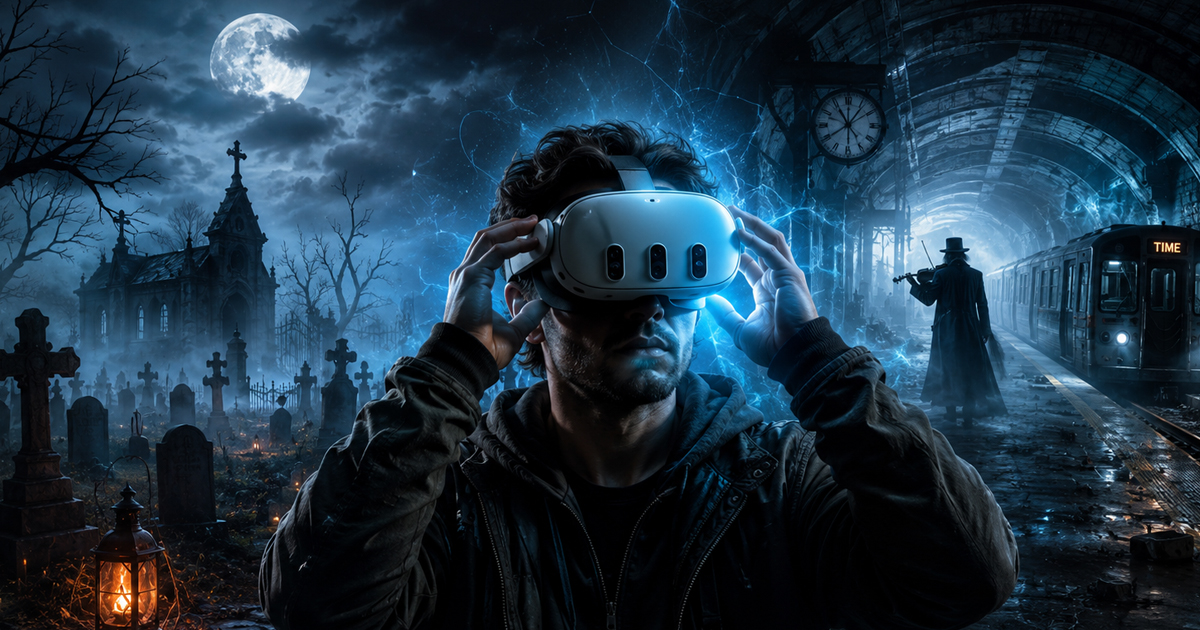
From 3D Art to Virtual Reality
From the beginning, my goal was simple: to bring ideas to life and use 3D art as a way to express creativity. I never wanted to specialize in a single discipline. Modeling, animation, audio, video editing, storytelling… I wanted to understand the entire process. Since this has always been a passion rather than my profession, I learned everything on my own.
Over the years I created 3D videos, TV commercials, and promotional content using Blender. Then one day, while exploring new features, I discovered the possibility of rendering stereoscopic 360° images. Curiosity immediately took over.
I bought a simple Google Cardboard headset, loaded the image onto my smartphone, and experienced my first scene in virtual reality. I was amazed. Suddenly, I wasn't just looking at a picture—I was inside it.
My second experiment was a Halloween cemetery scene filled with pumpkins. I added small horror animations, rendered the sequence in 360°, converted it into a video, and added sound. Rendering only two minutes took more than twenty hours, but the result felt magical.
My Early Experiences with VR
Before that, I had already uploaded a small 360° project to YouTube. Someone from the VR community discovered it and invited me to publish content on Veer.tv. I uploaded my cemetery experience and something unexpected happened: people loved it.
Within a month, I had over one thousand followers. Encouraged by the response, I decided to create something much more ambitious: a horror story called The Violinist.
Everything was created in Blender, frame by frame, and rendered in 360°. The process was painfully slow. A small mistake could mean hours or even days of additional rendering. But after months of work, I finally finished it and published it.
The audience response exceeded my expectations. My follower count quickly grew beyond five thousand, and Veer's Creator Manager even offered financial support for render farms. Despite upgrading to powerful NVIDIA GPUs, rendering times remained the biggest obstacle.
Searching for alternatives, I discovered Unity.
That discovery changed everything.
Real-time rendering felt almost magical compared to traditional workflows. The visual quality was impressive, it integrated perfectly with Blender assets, and best of all, iteration became incredibly fast.
After more than a year learning Unity, I revisited my horror and science-fiction universe with The Violinist and The Violinist II, stories set in a mysterious subway station outside time itself.
At that point, I knew that horror, mystery, and science fiction were genres perfectly suited for virtual reality.
Building Interactive VR Experiences
As I improved my cinematic skills, I had the opportunity to collaborate on a project for the 35th anniversary of the Regional Parliament of Extremadura.
Using photographs and architectural plans, I recreated in 3D the original parliamentary chamber, which no longer exists. The experience allowed visitors to explore the building in VR using a smartphone and Cardboard headset, interact with elements, and watch historical videos.
Seeing people visit a place that had disappeared decades earlier convinced me that VR was much more than entertainment. It had the power to create presence.
But, as always, I wanted to go further.
Why Meta Quest?
Eventually, I decided to move beyond 360° videos and create fully interactive experiences. I purchased my first standalone headset and later upgraded to a Meta Quest 3.
The freedom offered by Meta Quest impressed me immediately. No cables, no external sensors, and a huge user base made it the perfect platform for independent developers like me.
Meta Quest allows players to experience VR anywhere, while providing powerful hardware capable of delivering immersive games. Unity's support for the platform is excellent, and Meta has built a solid ecosystem for developers.
Of course, publishing on Meta's platform means meeting strict quality and performance requirements. Optimization, comfort, frame rate stability, and user experience are essential. These challenges have become part of the development process and are goals I am constantly working toward.
What Does Immersion Bring to Horror?
Horror has always fascinated me, but virtual reality transforms fear into something completely different.
In traditional games, danger remains behind a screen. In VR, danger surrounds you.
Dark corridors feel claustrophobic. Sounds become unsettling. Looking over your shoulder becomes a natural reaction. Even simple situations can create tension because your brain accepts the environment as if you were physically there.
That's why I believe horror, mystery, and science fiction are among the most powerful genres for virtual reality.
The Birth of Ghoulstorm
When I put on the Meta Quest 3, one thought immediately came to mind:
"Why not create my own VR horror shooter?"
That question marked the beginning of Ghoulstorm.
The project combines everything I've learned over the years: 3D art, storytelling, animation, sound design, Unity development, and my passion for immersive experiences.
Ghoulstorm is more than my first VR game.
It is the culmination of a journey that started with a simple 360° image rendered in Blender and evolved into the dream of creating a true horror experience where players are not merely spectators, but participants inside the nightmare itself.
